4,616dictionary entries behind the Qur’an’s 77,430 words
If you pray all five daily prayers, you recite Surah Al-Fatiha at least 17 times a day, once in each of the 17 obligatory rak’ahs. Yet according to Pew Research Center, only about 20% of the world’s Muslims live in the Arabic-speaking Middle East and North Africa. For most of the other 80%, those daily words are memorized sounds rather than understood sentences. When you learn Quranic Arabic, the Qur’an stops being a text you read through a translation and becomes one you follow directly: its meaning, its structure, and the nuances that English often flattens. Our live online classes are built for working adults. You learn the grammar, word patterns, and vocabulary of the Qur’an step by step, without needing years of full-time study.
17×Surah Al-Fatiha recited every day across the obligatory prayers
~20%of the world’s Muslims live in the Arabic-speaking Middle East and North Africa
80%of Muslims live outside the Arabic-speaking world
At a glance
Quranic Arabic Course Online: Key Details Before You Enroll
Who it’s for
Adults, from complete beginners upward
Format
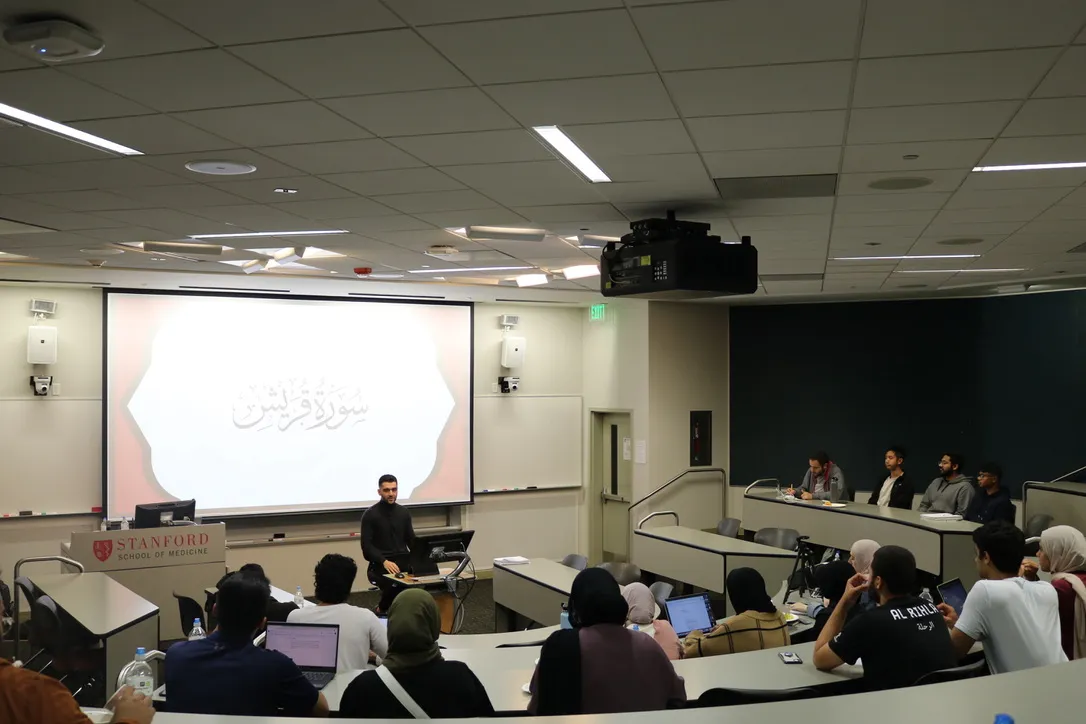
Live online classes with a qualified instructor
Prior Arabic needed
None
Missed classes
Recordings available
What you learn
Nahw (grammar), sarf (morphology), Qur’anic vocabulary, and reading with comprehension
Schedule
2 hours per week; weekday evening, weekend, and sisters-only sections (Pacific Time)
The most common reason adults never start is the belief that they would need to memorize tens of thousands of Arabic words. The numbers tell a different story.
The Quranic Arabic Corpus, a word-by-word linguistic annotation of the full text, counts 77,430 words in the Qur’an. Most of those are repetitions. A 2025 morphological study of the Qur’an (QuranMorph) identified 19,009 unique word forms. When those forms are traced back to their dictionary entries, they reduce to just 4,616 unique lemmas.
77,430words in the Qur’an
Quranic Arabic Corpus
19,009unique word forms
QuranMorph, 2025
4,616unique lemmas (dictionary entries)
QuranMorph, 2025
The reason is the Arabic root system. Most Arabic words are built from a three-letter root that carries a core meaning. Fixed patterns then generate related words from it. Take the root ع-ل-م (ʿ-l-m, “knowledge”):
ع ل مroot: ʿ-l-m, “knowledge”
عَلِمَʿalima: he knew
عِلْمʿilm: knowledge
عَالِمʿālim: a scholar
عَلِيمʿalīm: all-knowing, one of the names of Allah
تَعَلَّمَtaʿallama: he learned
مُعَلِّمmuʿallim: a teacher
Learn the root and the pattern once, and you can recognize the whole family wherever it appears in the Qur’an.
A small set of words also carries a large share of the text. These are the 10 most frequent verbs in the Qur’an, based on Quranic Arabic Corpus data:
The 10 most frequent verbs in the Qur’an
Rank
Verb
Meaning
Occurrences
1
قَالَ(qāla)
to say
1,618
2
كَانَ(kāna)
to be
1,358
3
ءَامَنَ(āmana)
to believe
537
4
عَلِمَ(ʿalima)
to know
382
5
جَعَلَ(jaʿala)
to make, to set
340
6
كَفَرَ(kafara)
to disbelieve
289
7
جَآءَ(jāʾa)
to come
278
8
عَمِلَ(ʿamila)
to do, to work
276
9
آتَى(ātā)
to give
271
10
رَءَا(raʾā)
to see
271
Together, these ten verbs appear more than 5,600 times. When you study Quran Arabic in order of frequency, every hour of vocabulary work pays off across hundreds of verses. That is why our lessons introduce the Qur’an’s most common words from the very first class.
Choose the right Arabic
Quranic Arabic vs Modern Standard Arabic vs Dialects
Many adults sign up for a general Arabic course and spend months learning to order food or ask for directions. Before you choose a program, know which Arabic you actually need.
Quranic Arabic compared with Modern Standard Arabic and spoken dialects
Quranic (Classical) Arabic
Modern Standard Arabic (MSA)
Spoken dialects
What it is
The Arabic of the Qur’an, hadith, and classical scholarship
The formal Arabic of today’s news, books, and official documents
Everyday regional speech, such as Egyptian, Levantine, or Gulf Arabic
Grammar
Full classical grammar, including case endings (i’rab)
Largely the same grammar, often simplified when spoken
Different grammar; case endings dropped
Vocabulary
Classical and religious vocabulary
Classical base plus modern terms
Heavily regional vocabulary
What it unlocks
The Qur’an, tafsir, hadith, classical texts
Media, modern literature, formal writing
Conversation within one region
Our Quranic Arabic classes focus on Classical Arabic, the language of the Qur’an. Because Modern Standard Arabic shares most of its grammar, this foundation also gives you a head start if you later want to learn modern Arabic.
A focused goal
Why Learning Quranic Arabic Is More Achievable Than You Think
The U.S. Foreign Service Institute places Arabic among its hardest languages for English speakers. It estimates around 88 weeks (about 2,200 class hours) of full-time study to reach professional working proficiency. That figure scares many people away. But it measures something very different from what most Muslims want.
Professional proficiency means speaking, writing, and understanding news, negotiations, and conversation on any topic. Understanding the Qur’an is a narrower goal. It means mastering one register of the language, a defined vocabulary of 4,616 lemmas, and a grammar system that repeats predictably across the text. When you learn Arabic for Quran online with a focused curriculum, you skip the parts of the language you don’t need. Your study hours go straight to what you do need.
Professional proficiency (FSI)~2,200 hoursSpeaking, writing, news, negotiations, and conversation on any topic
Understanding the Qur’an4,616 lemmasOne register, one defined vocabulary, and grammar that repeats predictably
Why live classes
Why Apps and Videos Alone Rarely Get You There
Vocabulary apps and free videos are great for motivation and word drills. But most adults who rely on them alone hit the same wall: they recognize individual words but cannot understand a full sentence. Following a verse requires grammar, and grammar requires feedback from someone who can correct you.
Vocabulary apps and free videos compared with live online classes
Vocabulary app
Free videos
Live online classes
Teacher correction
No
No
Yes, during every class
Grammar depth
Basic or none
Varies, often scattered
Structured nahw and sarf from beginner upward
Clear learning path
Word lists
Disconnected topics
Sequenced levels that build on each other
Reading real Arabic texts
Rarely
Rarely
Yes, as part of the course
Questions answered
No
Comments, if at all
Live, in class
Accountability
Streaks and badges
None
Weekly classes and assessments
Online Quranic Arabic classes close that gap. Short explanations are followed by guided practice, and an instructor checks your grammar and pronunciation as you work.
Curriculum
Your Quranic Arabic Learning Path
Learning Quranic Arabic online works best when every lesson builds on the last. Our course takes you through five stages, each with a clear outcome.
1
Stage 1: Foundations
You learn how Arabic sentences are built: nouns, verbs, and particles, along with the most frequent words in the Qur’an.
By the end, you can: identify the parts of a sentence and recognize high-frequency Qur’anic words on sight.
2
Stage 2: Word Patterns and Verb Forms
You learn the root-and-pattern system and the main verb forms, which explain how one root produces many related words.
By the end, you can: take an unfamiliar word apart, find its root, and estimate its meaning.
3
Stage 3: Sentence Analysis and Translation
You learn to analyze full sentences, including i’rab (grammatical case), and translate them accurately.
By the end, you can: read short verses, explain their grammar, and translate them yourself.
4
Stage 4: Reading Without Vowel Marks
You practice reading text without harakat (vowel markings), applying grammar instead of guessing.
By the end, you can: read unvoweled Arabic, the format of most classical books.
5
Stage 5: Reading the Qur’an and Classical Texts
You read longer Qur’anic passages and classical commentary (tafsir) in Arabic, with guidance that becomes lighter over time.
By the end, you can: read and understand Qur’anic passages directly and continue learning independently.
This is what turns a Quranic Arabic course from a collection of lessons into real comprehension: a clear route from your first grammar rule to reading the Qur’an on your own.
What you’ll study
What You’ll Study: The Four Pillars of Quranic Arabic
نَحْو
Nahw (grammar):
Sentence structure, word order, and case endings, which tell you who did what to whom in a verse. Classic primers such as Matn al-Ajurrumiyyah, written by Ibn Ajurrum in the 14th century, have taught these rules to students for over 700 years.
صَرْف
Sarf (morphology):
The system of roots and patterns that lets one root produce dozens of related words. Sarf is what makes a vocabulary of 4,616 lemmas manageable.
مُفْرَدَات
Vocabulary:
Regular drills focus on the words that appear most often in the Qur’an, so your effort goes where it counts.
تَفْسِير
Tafsir basics:
Once you can read a passage, you explore its meaning. Recitation becomes comprehension, and you begin to notice the linguistic details that translations cannot fully carry.
Built for adult life
How Our Online Classes Work
Learning has to fit real adult life: work, family, and everything in between. Our classes are designed around that.
Live instruction:
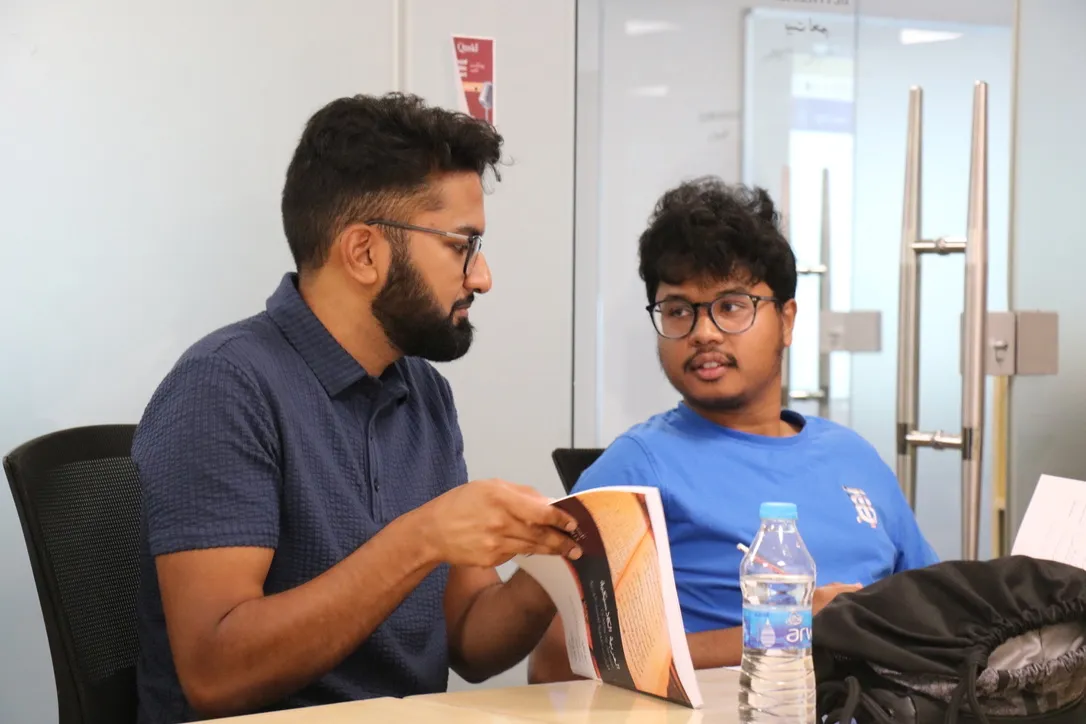
A qualified instructor teaches every lesson in real time, answering your questions and correcting mistakes as they happen.
Class recordings:
Every session is recorded, so if you miss a class you can catch up fully before the next one.
Practice and review:
Regular exercises and short assessments help you retain grammar and vocabulary from one week to the next.
Beginner-friendly pacing:
Lessons assume no prior Arabic and move at a steady pace that a busy working adult can sustain.
Spring Semester 2027
Choose Your Class Time and Enroll
January 11th to May 27th · No classes during Ramadan
Full refunds are offered to students who withdraw before the 4th class of the term. There’s no long-term contract beyond the current semester.
Student reviews
Hear From Our Students
“An incredible investment to connect with the Quran.”
Alhamdulillah, this course was an incredible investment to connect with the Quran. I highly recommend it to anyone looking to truly understand the precise linguistic nuances that get lost in English translations. Arhum is a master instructor—clear, precise, and exceptionally generous with his time outside of class to ensure practical mastery.
ZMZuhayeer MusaCo-Founder, Levels.fyi
“A flexible way to incorporate Arabic into your day to day life”
When I found out about Kitaab Academy, it seemed like the perfect opportunity to learn Arabic while meeting the demands of my work schedule. Our instructor is fantastic and always available to answer questions and assist outside of the class hours. I already feel like I’ve learnt so much over the past three months and can’t wait to see where I’ll be. If you want to learn and are looking for a flexible way to incorporate Arabic into your day to day life, look no more!
TKTasnim K.Resident Physician, Stanford
“I literally cannot praise this class enough!”
One concern I had going into this class is if I’ll have the energy to sit through an hour and a half of class after a long day at work. The answer is yes. The class is actually pretty fun and engaging because it’s just a short lecture where you can interrupt anytime with questions and then group work where we get to practice while the instructor comes around to check in on us every few minutes. I literally cannot praise this class enough!
OAOmar AbdelazizCo-Founder of Blue
FAQ
Frequently Asked Questions
Do I need to know Arabic before I start?
No. The course starts from the foundations of Arabic grammar and vocabulary, so complete beginners are welcome. Being able to read the Arabic script is helpful, but you can begin while you are still improving your reading.
How long does it take to understand the Qur’an?
It depends on how much time you study each week and how consistent you are. Most learners start recognizing common words and simple sentence patterns within the first stage. Understanding longer passages comes gradually as grammar and vocabulary build together.
Is this Modern Standard Arabic or a dialect?
Neither. The course teaches Classical Arabic, the language of the Qur’an. Because MSA shares most of its grammar, this foundation will also help if you study modern Arabic later.
I work full-time. Can I keep up?
Yes. The classes are designed for working adults, and recordings let you catch up when work or travel interferes.
I’ve tried learning Arabic before and quit. What’s different?
Many programs are either too scattered (apps and videos) or paced for full-time students. This course follows one clear learning path, focuses only on the Arabic you need for the Qur’an, and gives you live feedback from an instructor.
Can I learn Quranic Arabic without a teacher?
You can build vocabulary on your own. Grammar is much harder to master alone, because you need someone to correct your mistakes and explain why a sentence works the way it does. Most adults progress faster and stay more consistent with live instruction.
Who is this course for?
It is designed for adults: working professionals, students, parents, and anyone who wants to understand the Qur’an in its original language.
Start Understanding the Qur’an in Its Own Language
You don’t need years of full-time study to understand what you recite. You need a focused curriculum, consistent weekly practice, and a teacher who corrects you along the way. Take the first step toward reading the Qur’an with understanding.